Art Using Supplies From Cast Making Foam Wire Scluptures
Reinforced physical sculptures can be made from materials readily available from your local building material shop, and these make great long-lasting bases for mosaic sculpture. In fact, if you thoroughly seal the finished mosaic with an outdoor physical sealer, then the mosaic could final as long as anything made by the ancient Greeks or Romans.
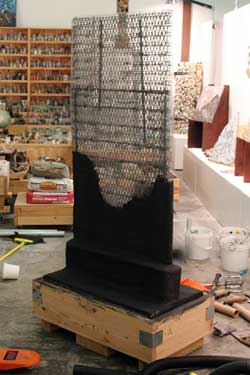
Another bang-up thing virtually using reinforced concrete as the base for your mosaic sculpture is that there are many techniques and materials that you can employ, and you can even make hollow shapes like spheres.
The start step in making a sculpture is to build a load-begetting frame, usually out of welded rebar or angle iron (or whatever scrap steel is available), but people without access to a welder can just drill holes in the bending fe and commodities their frame together. Expanded metal is likewise useful for flat shapes.
The next step is to encompass the frame with wire mesh, normally either chicken wire or hardware cloth, both of which are available at almost whatsoever edifice material store. The chicken wire or hardware cloth is "tied" to the frame with bare wire. Nosotros normally use fencing wire ties, which are sold for wiring fencing to contend posts, or physical wire ties, which are sold for holding rebar in place. You can utilise whatever bare steel wire you have on manus, but I would avoid aluminum or copper considering these metals volition corrode steel over time. Ordinarily 1 or 2 layers of hardware cloth are sufficient to form a surface upon which concrete tin can be spread, only three or more layers of chicken wire may be needed before your surface is firm enough. It really all depends on whether or not yous are making a hollow sculpture or ane that volition be filled with physical.
For hollow sculptures, expanding foam (from the building material store) can exist squirted in to make full the void inside your wire frame shape. The advantage of using expanding cream is that once the foam hardens, you lot will have something inside the wire-mesh skin of your sculpture when you start spreading concrete on information technology so that the wet concrete doesn't just fall through. Another reason to use the cream is that information technology volition preclude moist air and water from rusting your steel frame from the inside over time. One thing you take to watch out for with expanding foam is the potential to use too much and accept it expand into the wire mesh skin. Keep in mind that the wire mesh skin needs to exist encased in concrete and not be merely underneath a layer of concrete. If the physical is just sitting on top of the wire-mesh skin and not integrate with it, then it will probably intermission off over time like a piece of eggshell. On way to preclude the foam from expanding into the wire-mesh peel is to squirt the cream within a trash purse inside the frame. The cream will expand within the bag, and bag will keep it from extruding through the wire-mesh pare.
Concrete is traditionally spread with trowels, and trowels are useful for scooping upwards concrete and pressing information technology onto the surface of your mosaic, but you will probably find that working it into the wire past hand works all-time. The wire tends to puncture fifty-fifty the heaviest of prophylactic gloves, so we utilize a cheap pair of work gloves.
Ordinary concrete isn't the best option for sculptures because ordinary concrete isn't sticky enough, and information technology isn't strong enough in terms of tensile strength (in spite of having great compressive strength). The authors of well-nigh mosaic books explain how to add latex additives to portland cement to make a sticky physical, merely why would you do that when you could just go buy a purse of thinset mortar? I doubtable these authors are merely trying to posture as artists and demonstrate their technical competence, merely I call back they forget how many people they discourage by making things harder than they need to exist. Nosotros use thinset mortar mixed with pea gravel in a 2:1 ratio (thinset:pea gravel). Nosotros sieve the pea gravel to remove all the bigger pieces that won't fit into the wire-mesh peel.
At that place are a lot of different techniques used past various artists, including coating rags with thinset and layering these rags onto the frame like newspaper mache. You tin find additional instructions and ideas online.
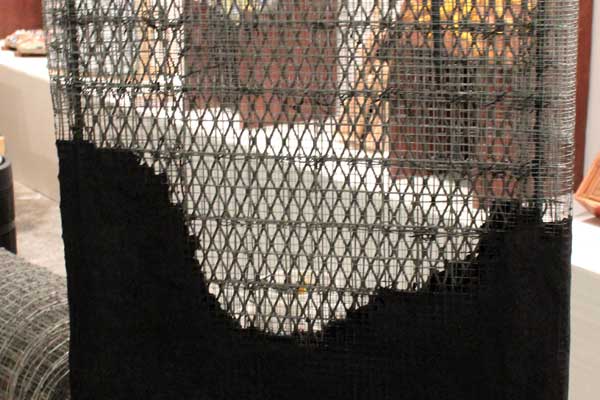
In recent years people have begun using hollow fiberglass shapes as bases for outdoor mosaic sculptures. Fiberglass bases might have the advantage of beingness lighter than traditional physical bases, just fiberglass bases can't as easily be made using local materials and fiberglass work requires noxious chemicals. That is why when you meet a mosaic sculpture made on fiberglass base, the base was almost always pre-made in a factory in a mold, which isn't of much use to an artist wanting to create his or her own vision. Also, hollow fiberglass mosaic shapes can flex slightly while mosaic tile and grout cannot, so the durability of mosaic sculptures made on fiberglass bases is questionable, at least in my opinion.

Post a Comment for "Art Using Supplies From Cast Making Foam Wire Scluptures"